


Aluminium in construction
A strategic material, not just an alternative
In many construction projects, material selection is still approached as a downstream decision - often driven by cost, availability or familiarity. In practice, however, it directly influences structural behaviour, design flexibility, lifecycle performance and, increasingly, environmental accountability.
Aluminium, particularly 6000-series alloys such as EN AW 6060 T66, EN AW 6063 T66 and EN AW 6005A T6, offers a combination of properties that align well with the demands of modern construction. Its strength-to-weight ratio enables lighter structures and more efficient load distribution, while its natural corrosion resistance reduces long-term maintenance requirements, particularly in exposed or external environments.
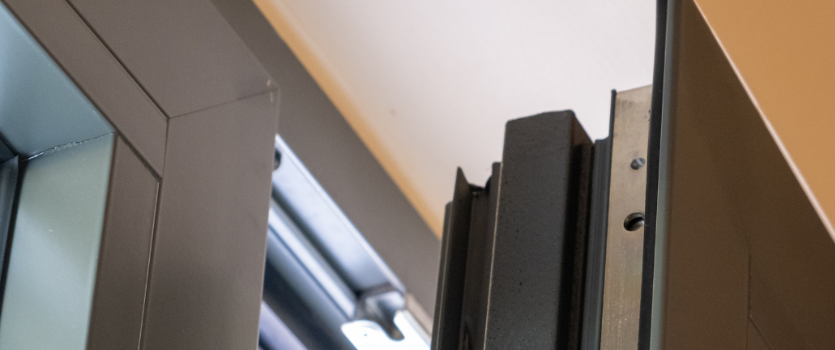
Where aluminium becomes strategically relevant is in its compatibility with extrusion technology. Unlike steel or stainless steel, extrusion enables highly controlled and complex cross-sectional geometries. This allows multiple functions to be integrated into a single profile, such as load-bearing capacity, connection interfaces, drainage, thermal performance or fixing points, reducing the need for secondary components and simplifying assembly.
This principle is widely applied across construction systems including cladding, ladder & access solutions, and window, door and curtain walling frameworks, where dimensional accuracy, repeatability and integration directly affect installation efficiency and overall system perform4Centered Image (NEW)addexpandmore-dots ImageAttach image Image (UK)Attach imageOptional: overrides the default image for UK locale ance.

From a sustainability perspective, aluminium also aligns with the growing importance low carbon and recycled content selection.
However, the real value of aluminium is not defined by the material alone, but by how early it is considered in the design process. Early-stage design collaboration not only encourages the use of mating standard components, but also ensures:
optimisation of profile geometry to reduce weight and material usage
alignment of alloy selection with structural and environmental requirements
integration of manufacturability into the design, avoiding later-stage compromises
In that sense, extrusion is not simply a production method, but a design tool.
For construction teams operating in a context of increasing complexity and performance demands, the question is shifting: not whether aluminium can replace traditional materials, but how it can be applied strategically and integrally from the outset.
A conversation that has been ongoing for more than 35 years and is more relevant today than ever.

How will you apply aluminium from the outset?
Make aluminium part of your strategy from day one with BOAL Extrusion as your partner in early-stage integration.
Read more

Reliable extrusion begins before the press runs
In custom aluminium extrusion, reliability is shaped before production starts. Not on the press, not at dispatch, but in the way an enquiry is underst...
Read more
A good extrusion partnership starts with the right conversation
For customers looking for custom aluminium extrusions, the first conversation can reveal far more than price or lead time. It helps determine whether...
Read more
Aluminium adds value
The well-known advantages of aluminium are clear enough: lower weight, corrosion resistance, design flexibility and faster installation. Yet in practi...
Read more