

In a greenhouse, everything is connected.
An aluminium profile for horticulture is not designed in isolation
A few grams less aluminium per metre. An additional drainage chamber. A critical tolerance that needs to be maintained over many metres. A connection that eliminates the need for two separate components. Or the choice of aluminium with a lower CO₂e footprint. On the drawing board, these may seem like separate decisions. In a greenhouse, they are not.
An aluminium profile is part of a larger system within a greenhouse. It supports, connects, guides, drains water or provides the basis for moving components. Sometimes a single profile performs several of these functions at once. A change in geometry, wall thickness, alloy or tolerance can therefore affect load-bearing capacity, production, assembly, automation, material use and ultimately the performance of the entire system. That is why an important part of optimising an aluminium profile takes place before the die is made.
Not as light as possible, but material where it is needed
Reducing weight may seem an obvious way to reduce material use and costs. But simply making a greenhouse profile thinner is rarely the answer. The real question is where the aluminium is technically required.
A profile used in a greenhouse roof, façade, ventilation window or internal transport system is subject to specific loads and functional requirements. The profile geometry, selected alloy, wall thicknesses and reinforcements therefore need to work together. In some areas, material may be reduced, while elsewhere a rib, chamber or modified geometry may be needed to provide sufficient stiffness or functionality. That distinction matters.
Good design is not about achieving the lowest possible weight, but about using material as purposefully as possible. A few grams per metre may seem insignificant. Across large production volumes, however, the same design decision can be repeated thousands of times. Small optimisations can then become relevant in terms of material use, weight, logistics and cost.
Light also requires a technical balance
In horticulture, material use has another dimension. Daylight is an important factor in how a greenhouse performs, and the structure surrounding the crop influences how much of that light actually reaches it.
A slimmer aluminium profile can help reduce shading. At the same time, the profile still needs to meet the requirements of the overall greenhouse system, including wind and snow loads, installed equipment and site-specific conditions. Here too, no single design variable can be considered in isolation.
Wall thickness, profile height, geometry, alloy, strength, extrudability and material use all influence one another. A change that appears beneficial from one perspective must therefore always be assessed in the context of the profile's overall function.

Water follows the geometry we design
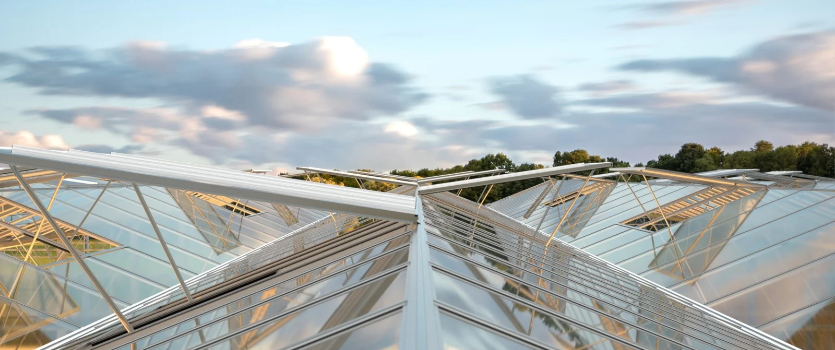
The same applies to water management. Rainwater and condensation need to be collected and drained in a controlled way. How this happens is not determined solely by the systems around the profile. The geometry of greenhouse and condensation gutters, drainage chambers, drip edges, connections and interfaces helps determine where water collects and the route it subsequently takes. Water management therefore becomes relevant at the profile design stage.
A well-designed cross-section can also combine several functions. Drainage, fixing or connection functions do not always require a separate component. Where functions can be technically integrated into a single extrusion profile, this can reduce the number of components and connections and simplify assembly.
The interesting question, therefore, is not only what the profile itself looks like, but also which functions it can perform within the overall system.
Automation makes deviations more visible
This systems approach becomes even more important when aluminium profiles form part of automated growing and transport systems.
A growing bench, shuttle or other moving component does not need to reach the correct position just once, but repeatedly – over longer distances and after many movements. Dimensional accuracy, straightness, tolerances, connections and repeatability then become directly relevant to the reliability of the system.
A small deviation in a single profile may not appear significant in isolation. However, if the same deviation continues across multiple profiles or along a long installation, its effect can become greater. Repeatability therefore goes beyond meeting the specified dimensions of a single product. It also requires attention to the alloy, heat treatment, extrusion process, cut length and any mechanical machining.
For an automated application, ‘approximately right’ is ultimately not good enough.
Sustainability does not begin with a single material choice
When considering sustainability, it can be tempting to focus on one characteristic: recycled aluminium or low-carbon aluminium. But the overall material impact of a profile is determined by more than that.
The amount of aluminium required by the design matters, as do the origin of the material, its recycled content, the energy used for primary production, transport, additional processing, service life and the opportunities for recycling at the end of its useful life.
At the same time, material origin and CO₂e data are becoming increasingly relevant from a commercial perspective. Regulations such as CBAM, together with growing information requirements from customers and supply-chain partners, make it increasingly important not only to make material choices, but also to be able to substantiate them where required.
With BLUE by BOAL, we can offer, among other options, aluminium with a minimum recycled content of 65% and a low-carbon option with a footprint of no more than 4 kg CO₂e per kilogram of aluminium.
But the same principle applies here: material selection and profile design belong together. Using low-carbon aluminium can make a difference. So can avoiding aluminium in parts of the profile where it serves no technical purpose.
The die is an important turning point
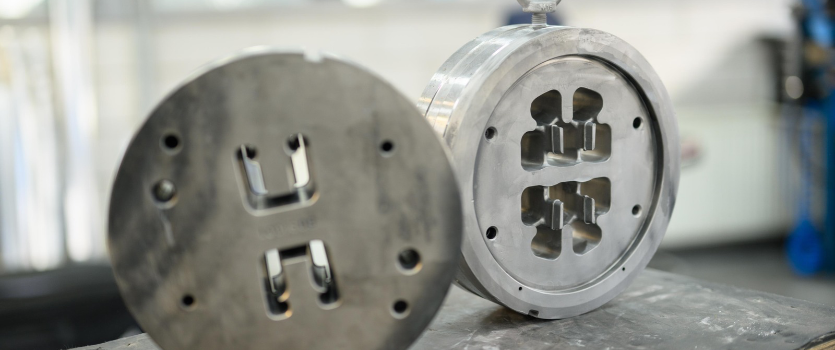
Many of these considerations ultimately come together at the same point: before the design is finalised and the die is made. If a fully developed profile only reaches the extrusion partner at that stage, it may prove perfectly suitable for production. But it may also mean that opportunities for optimisation can no longer be explored because other parts of the system have already been designed around that geometry.
Early technical collaboration does not necessarily mean that a design needs to be completely reworked. Sometimes the review simply confirms that the chosen solution is already a good one. In other cases, it may reveal that a wall can be made locally thinner, a critical tolerance can be approached differently, functions can be integrated or the geometry can be adjusted to make the profile easier to extrude reliably and consistently.
That is the value of co-engineering: not designing for the customer, but bringing together technical knowledge of the application and aluminium extrusion expertise early enough for there still to be choices to make.
From aluminium profile to system question
Perhaps that is the most important conclusion. The question is not simply: can we extrude this aluminium profile?
The more interesting questions come before that. What does the profile need to do within the system? What loads does it need to withstand? Where is material genuinely required? Which tolerances are functionally critical? Can functions be integrated? How will water be managed? What demands does automation place on the profile? Which material choice supports the sustainability objectives? And can the resulting design then be produced reliably and consistently?
Answering those questions sometimes requires engineers, buyers, system developers and extrusion specialists to sit down together earlier than they normally would.
So, if there is a new greenhouse profile on the drawing board and the drawing is not yet final?
Good.
There is still time to look at it together.
Read more
Progress requires measurable aluminium choices
Aluminium is a material of progress. It is lightweight, strong, formable, durable and fully recyclable. In sectors such as solar, transport, electrica...
Read more
Build lighter, go further
In the transition towards sustainable mobility, efficiency is everything. Whether we are talking about electric vehicles or other low-emission applica...
Read more
From profile to system
In many architectural and structural projects, manufacturability is still too often treated as a follow-up step to the design. A logical assumption, b...
Read more