

From profile to system
Why extrusion starts in the design phase
In many architectural and structural projects, manufacturability is still too often treated as a follow-up step to the design. A logical assumption, but in practice also a risky one. Especially in projects where form, repetition and detailing are leading. It is precisely in these cases that the quality of the final result is not determined by the design alone, but by the extent to which engineering and production are integrated from the very beginning.
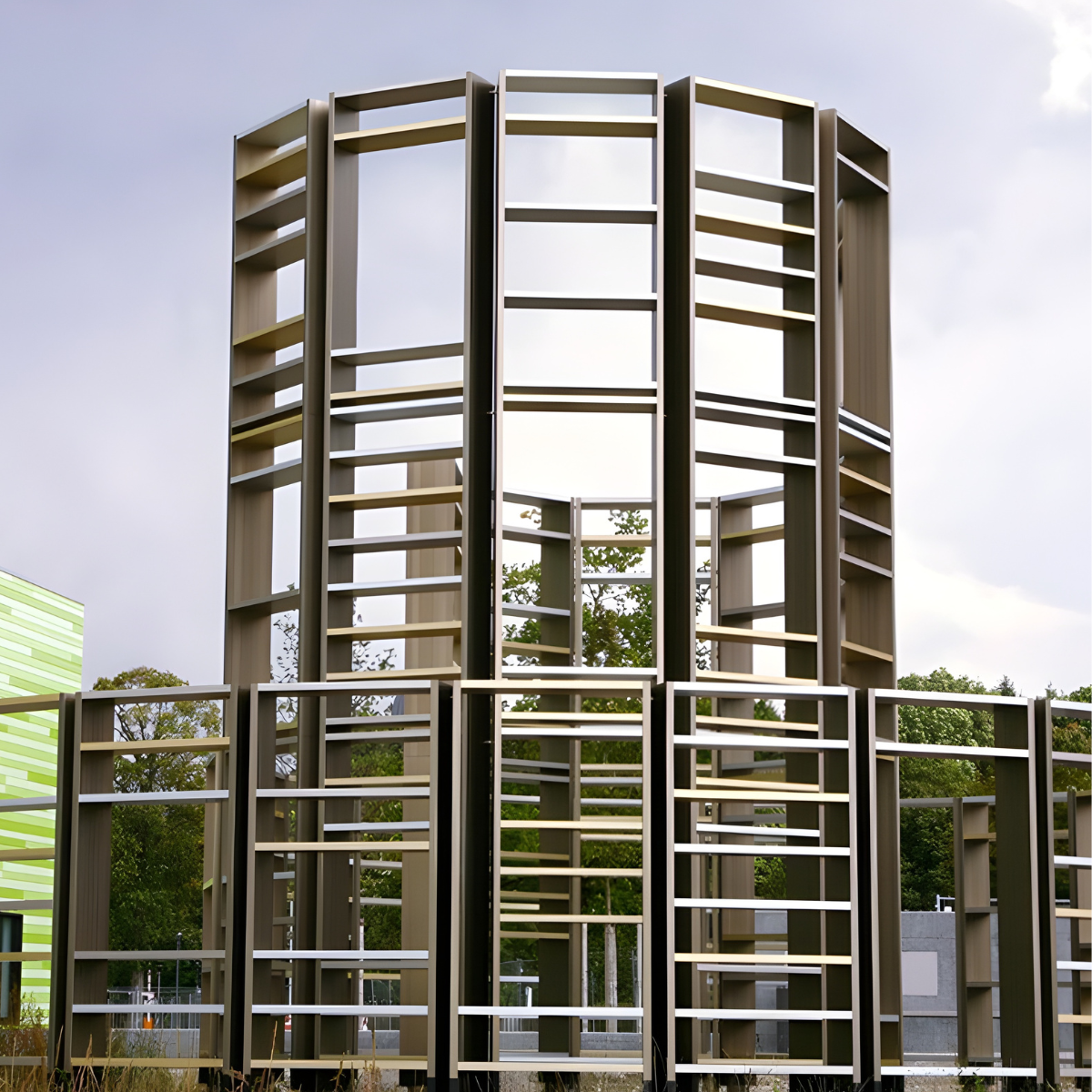
A recently completed project clearly illustrates this. For an outdoor structure inspired by the complexity of DNA, a fully aluminium load-bearing and shaping system was developed. The design is characterised by a seemingly clear visual language - repetitive, symmetrical and lightweight - yet structurally it requires a high level of precision and consistency. The result is an architectural object that conveys visual calm, while being technically refined down to the smallest detail. It is exactly within this tension between simplicity and complexity that custom extrusion plays its role.

Material selection as a starting point
For this project, an aluminium alloy from the 6000 series was selected. This series is known for its good extrudability, favourable strength properties and suitability for structural applications.
The combination of magnesium and silicon provides:
a good balance between strength and formability
excellent corrosion resistance
suitability for anodising, offering both aesthetic and functional benefits
For an application where profiles remain visible while also fulfilling structural functions, this combination is essential. The material not only supports the form, but also contributes to the durability and maintenance requirements of the overall structure.
From profile to system
The technical challenge in this project did not lie in the individual components, but in the system as a whole. The structure is built from repeating elements that are interconnected, placing high demands on both design and production.
This includes:
dimensional accuracy over the full length of the profile
consistent tolerances between individual components
reproducibility in serial production
“Deviations accumulate quickly in geometries like this,” says Ton Koldewijn, Technical Support Manager at BOAL Extrusion. “A minimal tolerance deviation in one element can already lead to visible misalignment or assembly issues further down the structure.”
This sensitivity requires control at an early stage. Not correcting afterwards, but designing for manufacturability from the outset. “That is why, during the design phase, we focused on optimising the profile geometry with stability and fit in mind,” Ton continues. “At the same time, we looked at integrating connection principles into the profile itself and reducing secondary operations.”
This fundamentally shifts the role of extrusion: from supplying a profile to developing a functional system component.
Co-engineering as a prerequisite
The complexity of the geometry and the aesthetic requirements made a traditional sequential approach unsuitable. Instead, a co-engineering process was adopted, in which design, engineering and extrusion expertise were developed in parallel.
Koldewijn: “This made it possible to directly test design intentions against manufacturability, iteratively optimise profile cross-sections, and incorporate production and assembly steps at an early stage.” The result is not only a technically feasible solution, but also a more efficient execution process.
Impact on assembly and total cost of ownership
An important effect of this integrated approach becomes visible during assembly. By integrating functions such as positioning and connection directly into the profile, complexity shifts from the construction site to the design phase.
“What you solve in the profile upfront, you no longer need to correct on site,” says Ton Koldewijn. This translates into:
fewer loose components and fasteners
shorter and more predictable assembly times
a lower risk of failure costs
In addition, the material choice, combined with anodising, contributes to a low-maintenance solution. This is particularly relevant for applications with a long service life and public exposure.
The initial investment in engineering and profile development therefore pays off across the entire chain - from production and assembly to use and maintenance.
Conclusion
Projects where architecture and construction are so closely intertwined demonstrate that extrusion is not a final step, but a design tool. This shifts the role of BOAL Extrusion as an extrusion partner: from producer to co-developer. And it is precisely in that shift that the difference is made.
“The application of a 6000 series aluminium alloy, combined with the early integration of extrusion expertise in the design process, makes it possible to realise complex geometries in a reproducible, aesthetic and structurally reliable way.”
Ton Koldewijn - Technical Support ManagerRead more
In a greenhouse, everything is connected
A few grams less aluminium per metre. An additional drainage chamber. A critical tolerance that needs to be maintained over many metres. A connection...
Read more
Progress requires measurable aluminium choices
Aluminium is a material of progress. It is lightweight, strong, formable, durable and fully recyclable. In sectors such as solar, transport, electrica...
Read more
Build lighter, go further
In the transition towards sustainable mobility, efficiency is everything. Whether we are talking about electric vehicles or other low-emission applica...
Read more