


Build lighter, go further
ALUMINIUM EXTRUSION IN SUSTAINABLE MOBILITY
In the transition towards sustainable mobility, efficiency is everything. Whether we are talking about electric vehicles or other low-emission applications, every kilogram matters. Reducing weight means extending range, lowering energy consumption, and ultimately cutting emissions over the vehicle’s lifetime. That makes lightweight construction one of the most powerful levers in the transport sector. Aluminium extrusion is playing an increasingly important role in this. Not just as a substitute for heavier materials, but as a way to create complex structural components that directly contribute to both weight reduction and functionality.
From weight to performance
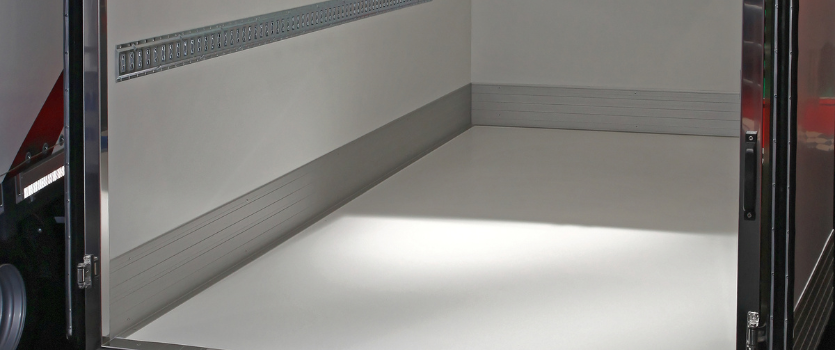
In recent transport projects, aluminium profiles have been used in lengths of over ten metres, directly integrated into load-bearing vehicle structures. Applications like these make it possible to combine parts, reduce joints, and create lighter constructions without compromising strength. Fewer components also mean fewer assembly steps and, therefore, less risk of errors.
The impact goes beyond weight savings alone. By integrating functions and reducing the number of parts, systems become more efficient and robust. Lower overall weight translates directly into reduced energy consumption per kilometre and extended range in electric applications, while also limiting assembly losses, tolerance stack-ups, and rejection rates further down the line.
“As soon as you bring multiple separate components together, tolerances start to stack up, and you inevitably introduce corrective work during assembly,” explains Elke Tabak-Keller. “By integrating functions into a single profile, you eliminate that variation. The result is less rework, lower scrap rates, and a more stable process — something you immediately see reflected in both cost and energy use.”

The challenge lies in when decisions are made
At the same time, the biggest challenge is not complexity itself, but the timing of decisions. As profiles become larger and more functional, the impact of design choices increases — while extrusion expertise is often only brought in at a later stage.
In practice, this means that geometries, tolerances, and machining steps are often already fixed before manufacturability has been fully assessed. Optimisation is then pushed further down the process, where flexibility is limited and adjustments lead to additional operations, corrections, and a higher risk of rejection. This is precisely where part of the intended sustainability gains from lightweight design can be lost.
Weight reduction starts with design, not material
“Many companies look at aluminium as the solution for weight reduction, but overlook the fact that the real gains are made in the design,” says Elke Tabak-Keller, Senior Account Manager specialising in transport applications. “If extrusion is only considered later in the process, you miss the opportunity to integrate functions and reduce processing steps. That means you’re not getting the most out of the material.”
"Many companies look at aluminium as the solution for weight reduction, but overlook the fact that the real gains are made in the design."
Elke Tabak-Keller - Senior Account ManagerMore than just a lighter component
In practice, lightweight design and sustainability do not automatically go hand in hand. A lighter component that requires multiple processing steps, transport movements, and corrections may ultimately be less efficient than a slightly heavier but more intelligently designed alternative.
The difference lies in how early extrusion is considered in the design process. When profile geometry, tolerances, and processing steps are developed in conjunction, components emerge that are not only lighter, but also easier to manufacture and assemble.
Where the real gains are made
In projects where this integration was applied from the outset, the benefits became visible across the entire value chain. Processes became shorter, variation decreased, and predictability improved. Less scrap, reduced handling, and fewer corrections resulted in a more stable and efficient production process.
This shifts the impact of lightweight construction: not only better performance in use, but also less waste in production and logistics.

Lightweight as a system choice
For manufacturers of sustainable transport solutions, this represents a fundamental shift. Lightweight construction is not just a material choice, but a system decision in which design, production, and supply chain are closely interconnected.
Those who apply aluminium extrusion strategically during the design phase can integrate functions, reduce the number of components, and at the same time lower complexity across the chain.
The real advantage
In a sector where every kilogram counts, the solution may seem simple: build lighter. But in reality, the difference is not made by the material alone, but by how it is applied.
The real advantage lies in combining lightweight design with a smart, integrated value chain. Or, put simply: if you want to go further, you need to start earlier.
Read more
Progress requires measurable aluminium choices
Aluminium is a material of progress. It is lightweight, strong, formable, durable and fully recyclable. In sectors such as solar, transport, electrica...
Read more
From profile to system
In many architectural and structural projects, manufacturability is still too often treated as a follow-up step to the design. A logical assumption, b...
Read more
Sourcing outside EU since CBAM
Now that CBAM is fully in force, the equation around international sourcing is changing. The question is no longer only where a product can technicall...
Read more